What Is DTS Monaco? A Complete Beginner's Guide
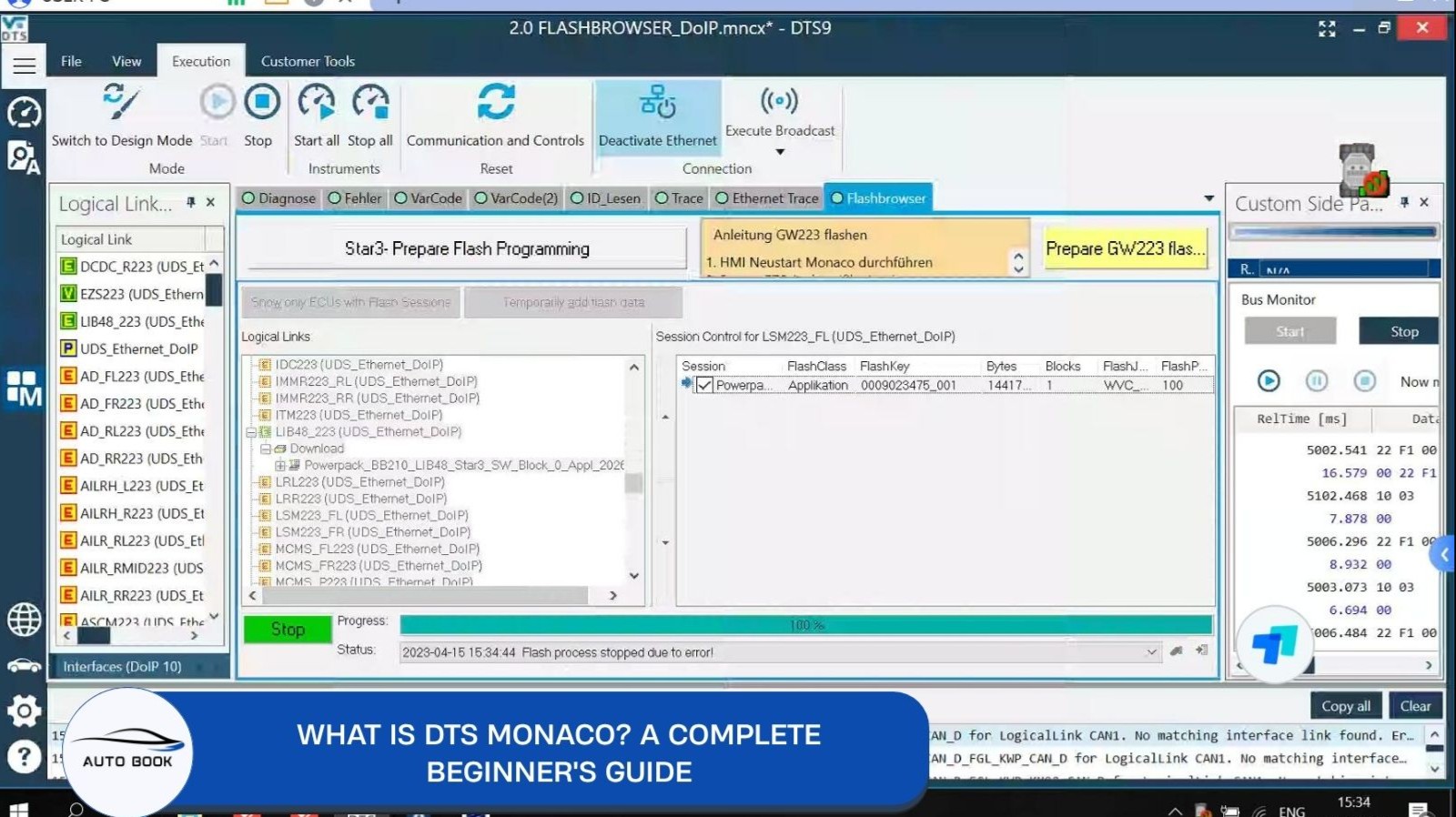
Spend enough time in Mercedes-Benz technician forums, and one name keeps coming up: DTS Monaco. It gets mentioned like everyone's already supposed to know what it does — but the honest answer to what is DTS Monaco rarely comes in plain terms. So let's actually break it down.
What Is DTS Monaco, Exactly?
DTS Monaco — short for Diagnostic Tool Set Monaco — is an engineering-level software developed by Softing for Mercedes-Benz vehicles. The name "Monaco" itself stands for Modular Analyzer for Vehicle Communication, which is a fairly accurate description of what it does: it analyzes and communicates directly with a vehicle's control units in a modular, flexible way.
DTS Monaco wasn't originally built for everyday repair shops. It was developed for use by Daimler-Benz development engineers, which is why it goes far beyond the diagnostic scope of a typical workshop tool — giving direct access to ECU-level coding, programming, and testing rather than just fault-code reading.
Where it fits compared to Xentry: Xentry is the diagnostic software most Mercedes-Benz technicians use daily — reading codes, running adaptations, guided troubleshooting. DTS Monaco sits a level above that: it's the tool used when the work goes beyond diagnostics into actually changing how a vehicle's systems are configured. (For a full breakdown, see our Xentry vs DTS Monaco comparison.)
In short: DTS Monaco is less a "scanner" and more an engineering platform — one built to let technicians and engineers get inside a Mercedes-Benz ECU and actually work with it, not just read from it.
What Does DTS Monaco Actually Do?
Once you get past the definition, the real question is what DTS Monaco actually lets you do inside a Mercedes-Benz ECU. Here's a breakdown of its core functions, in plain terms:
- Quick Test — Runs a fast scan across all of a vehicle's ECUs at once, giving a quick overview of system health before deciding where to dig deeper.
- Variant Coding — Changes ECU parameters to enable or disable specific vehicle features. This is the function behind tasks like adjusting settings, unlocking hidden comfort features, or modifying regional configurations.
- ID Identification — Reads and saves identifying information from every module in the vehicle, useful for documentation and for confirming exactly what hardware/software combination you're working with.
- Offline Flash Programming — Updates or reprograms ECU software without needing an active internet connection, which matters for technicians working without reliable SCN online access.
- DTC Diagnosis — Pinpoints diagnostic trouble codes at the module level, going deeper than a basic fault-code readout.
- ECU Exchange — Transfers data between two identical control units, useful when swapping a module and needing the replacement to match the original's configuration.
- Symbolic Trace — Records trace files during vehicle operation, which technicians use to analyze behavior and diagnose issues that don't show up as a simple fault code.
Together, these functions are what separate DTS Monaco from a standard diagnostic scanner — it's not just reporting what's wrong, it's giving direct access to reconfigure and reprogram how the vehicle's systems actually work.
How Does DTS Monaco Work?
DTS Monaco communicates directly with a vehicle's ECUs using standard automotive protocols — primarily CAN, DoIP, and FlexRay — depending on the ECU and vehicle platform involved. This direct communication is what allows it to read, code, and reprogram control units rather than just interpret fault codes.
Underneath that communication layer, DTS Monaco is built around established data standards: ODX, OTX, and UDS. In simple terms, these standards define how vehicle diagnostic and coding data is structured, so DTS Monaco can interpret an ECU's parameters consistently across different modules and vehicle configurations, rather than treating each one as a one-off.
What you need to actually run it:
- Xentry Diagnostic Software — DTS Monaco is typically used alongside Xentry, which is required for full functionality. It's not usually run as a fully standalone replacement for Xentry.
- A compatible interface (VCI) — commonly an SD Connect unit, matched to the version and vehicle type you're working with.
- The correct ECU database files — DTS Monaco needs files describing each ECU it connects to (what it is, what its coding options are), which vary depending on the exact vehicle and its configuration.
This combination — protocol-level communication, structured data standards, and the right supporting software/hardware — is what makes DTS Monaco capable of engineering-level work, but it's also why getting a working setup right in the first place takes real preparation.
Who Actually Needs DTS Monaco?
Not every Mercedes-Benz technician needs DTS Monaco — and that's worth being upfront about.
If your work is mostly diagnostics and maintenance — reading codes, running adaptations, guided troubleshooting, day-to-day repairs — Xentry already covers that. Adding DTS Monaco on top wouldn't give you much you're not already getting. (See our Xentry vs DTS Monaco guide for exactly where that line sits.)
DTS Monaco becomes relevant once your work moves into:
- Variant coding and customization — enabling or disabling features, adjusting configurations that go beyond standard settings
- ECU flashing and reprogramming — updating or modifying control unit software directly
- Working across a wide range of Mercedes-Benz platforms, especially newer models where deeper coding work is increasingly part of the job
- Engineering-style troubleshooting — using tools like Symbolic Trace to diagnose issues that don't present as a simple fault code
In practice, this tends to describe independent technicians and garages that regularly handle coding and customization requests, rather than shops doing purely routine service work. If that's the direction your work is heading — or already is — DTS Monaco is worth learning properly rather than picking up piecemeal from scattered forum posts.
Is DTS Monaco Difficult to Learn?
Honestly — yes, to some degree. DTS Monaco wasn't designed as a plug-and-play workshop tool; it was built for engineers, and that shows in how it's structured. Getting comfortable with it takes more than opening the software and clicking around.
Where most of the difficulty actually is:
- Initial setup — getting DTS Monaco correctly installed, connected to Xentry, and communicating reliably with a vehicle is often the first real hurdle, before any coding even begins.
- Understanding ECU data — knowing what you're looking at (ECU databases, coding parameters, variant options) takes time to build, especially since it varies by vehicle and configuration.
- Knowing what not to do yet — DTS Monaco doesn't warn you before or after a coding change, so part of learning it is understanding your own limits at each stage.
The good news: this difficulty is very learnable with the right structure — it's a matter of sequence, not talent. Trying to jump straight into advanced coding without a solid foundation is where most avoidable mistakes happen. Building that foundation first, then progressing into deeper coding work, is a much more reliable path. (Our DTS Monaco Beginner vs Advanced guide breaks down exactly what belongs at each stage.)
If you're just starting out, that foundation — installation, connection, basic diagnostics — is exactly what the Mercedes DTS Monaco Beginner Manual is built to cover.
FAQ
What does DTS Monaco stand for?
DTS Monaco stands for Diagnostic Tool Set Monaco. "Monaco" itself is short for Modular Analyzer for Vehicle Communication, describing its modular approach to analyzing and communicating with vehicle ECUs.
What's the difference between DTS Monaco and Xentry?
Xentry is the standard diagnostic tool for everyday fault-finding and maintenance. DTS Monaco is an engineering-level tool used for deeper coding, parameterization, and flashing — work that goes beyond what Xentry is designed to do. See our Xentry vs DTS Monaco guide for the full comparison.
Do I need Xentry to use DTS Monaco?
Yes — DTS Monaco is typically used alongside Xentry Diagnostic Software, which is required for it to function fully. It's not commonly run as a standalone replacement.
What's the difference between DTS Monaco and Vediamo?
Both are Mercedes-Benz engineering tools, but they're built for different eras of vehicle platforms and use different data structures. Our DTS Monaco vs Vediamo guide breaks down exactly where each one fits.
Where should a complete beginner start with DTS Monaco?
Start with the fundamentals — installation, vehicle connection, and basic diagnostic workflows — before moving into coding. Our DTS Monaco Beginner vs Advanced guide can help you figure out exactly where to begin.
DTS Monaco isn't a mysterious black-box tool — it's an engineering platform built to give technicians direct access to how a Mercedes-Benz's ECUs are configured, not just what's wrong with them. That access is powerful, but it comes with a real learning curve, and the technicians who use it well are the ones who built their skills in the right order rather than guessing their way through forum posts.
If you're just getting started, that's exactly what the Mercedes DTS Monaco Beginner Manual is designed for — a structured starting point instead of trial and error.